Conservation Fund Highlight – Demographic Response of Nesting Grassland Birds to Keystone Effects of Black-tailed Prairie Dogs

Spotlight: Dr. Andrew Dreelin, Northern Illinois University
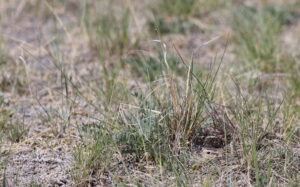
With numerous worthy conservation projects underway across the globe, Tracy Aviary is excited to provide support to various causes and research being conducted throughout Utah and beyond. For Dr. Andrew Dreelin, one of our recipients, his passion is dedicated to the Great Plains. The goal of his 5-year research project was to understand how prairie dogs affect nest survival of focal species in order to provide actionable evidence to help integrate prairie dogs into grassland bird conservation efforts and promote habitat diversity and incentive programs for ranchers.
While there has been some research on grassland conservation, he approached it with a unique angle that had not been explored previously. Prior studies showed that prairie dog towns were foraging hotspots for Burrowing Owls, with the owls being able to catch bugs faster in the open area. Other studies were done using artificial nests and found higher nest predation rates on prairie dog towns. The artificial nest results, however, did not provide actionable results for conservation planning. This motivated Andrew to pursue live monitoring of wild songbird nest success and their relationships with Black-tailed Prairie Dogs for his dissertation.
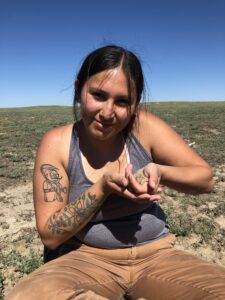
A grant from Tracy Aviary’s Conservation Fund allowed Andrew to hire and house a crew of field technicians to support his research, which made it possible for him to exceed his initial monitoring goals. It also allowed the project to continue monitoring for an additional 2 years and enabled comparisons of nest survival between drought years (‘21-‘22) and non-drought years (‘23-’24).
Dreelin also built strong community relationships, showcasing his commitment to community involvement in ecology. Two interns from Aaniih Nakoda College joined the field crew to gain transferable skills in biology, and as of now, have been hired at ANC to continue doing research and conservation work.
Andrew and his team monitored 69 Horned Lark (HOLA) nests and 57 Chestnut-collared Longspur (CCLO) nests in 2023, followed by 66 HOLA nests and 64 CCLO nests in 2024. It is important to note that Chestnut-collared Longspurs are only found in North America on the Great Plains, making this research all the more impactful.
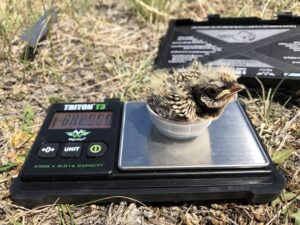
One of their key findings was that prairie dogs did not have direct negative impacts on nest survival, suggesting that prairie dog towns are not as risky for grassland birds as previously thought. Additionally, their data showed that the farther the nests were in the prairie dog towns, Horned Larks experienced faster growth rates, which caused them to fledge sooner. In Chestnut-collared Longspurs, it was noted they weighed more.
Fledging sooner and weighing more are important benefits that will help juvenile birds get a head start in life, which means prairie dog towns could serve as important nurseries, especially for Chestnut-collared Longspurs. Prairie dogs are valuable, and as a keystone species, these animals help hold the ecosystem together. Grassland birds are a steeply declining group, and finding new ways to support these species is crucial to ensure their survival.
Andrew aims to highlight the contributions prairie dogs bring to wildlife conservation, and hopes to continue this work as a postdoctoral research fellow. He is actively communicating his results to conservation professionals, land managers and fellow researchers across the country. Based in Chicago, he is dedicated to applied conservation work on grasslands, emphasizing the importance of a healthy prairie ecosystem. You can learn more about Dr. Andrew Dreelin and his work over at andrewdreelin.com.