The Crested Oropendola: From Chick to Adult
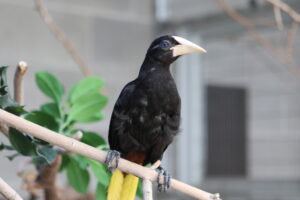
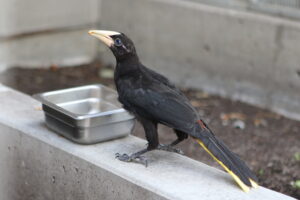
It was a nice October evening when Eric and I, one of our keepers, strolled over to view and talk about the Crested Oropendola in the South American Pavilion (SAP). With deep blue eyes, black plumage and bright yellow tail feathers, this bird is stunning to observe. He was jumping around the exhibit, exploring the habitat and curiously watching us gaze at him. His presence is a significant achievement for the bird care team — this male Oropendola is the first hand-reared of its species at Tracy Aviary. Read our conversation below!
What is the history in terms of raising hatchlings, specifically Oropendolas. Correct me if I’m wrong, but this was the first time our staff raised one.
We didn’t even have a protocol – hand rearing protocol is what we call it. Every bird that we’ve had a history with raising, or that we would like to hand raise at some point, would have a set guideline for rearing. These protocols discuss which food items to offer, which to avoid, as well as set temperatures for the bird’s housing brooder. In addition, the protocol also discusses milestones we should see from the chick like when its eyes open, when it gets feathers in, and when it should be ready to “leave the nest” or fledge.
Without the hand rearing protocol to guide us forward in the process, we had to come up with our own, borrowing bits and pieces from other protocols for birds with similar rearing strategies. For this oropendola, we used a Superb Starling and a Troupial hand rearing protocol to help form a blueprint.
The decision to hand rear this bird was made after the oropendola nest was physically checked via a ladder. We were confident they had eggs, but we weren’t seeing signs of the parents being attentive to the nest. Their estimated incubation period was ending and we thought checking the nest at this point would be beneficial if there was an egg that was having trouble hatching and needed assistance. This species is part of an SSP (Species Survival Plan) working to make sure their population is stable in 100 years across all AZA facilities that house them. For that reason, we wanted our birds to have a successful chick.
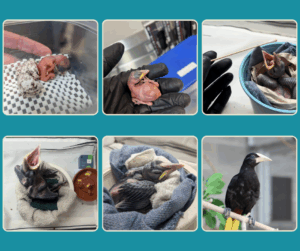
Upon checking the nest, one egg was observed to be “internally pipped”, meaning it had broken through the soft membrane in the shell to the aircell and was taking its first breaths on its own before gathering strength to break through the hard outer shell.
Due to the experience of our Aviculture staff with hand rearing other species, as well as previous issues with hatching chicks on exhibit with this species, we decided to hand rear it. From there I carried it across the Aviary in my hand while feeling it scratch the shell. We then placed it in a dish in one of our incubators before prepping our hatcher with extra humidity to help make the hatching process easier. While doing so, the chick fully hatched on its own.
From there we had little time to get our ducks in a row for the chicks rearing, as once they are hatched, they are typically close to ready for food. During the first day, the chick may still be absorbing some of its yolk, but that won’t keep the chick fed for long.
The biggest challenge with handrearing a Crested Oropendola is raising a bird that is not “imprinted”. Imprinting happens when a bird is hand reared with full view of their human care-takers. This can lead to behavioral issues with the bird in relation to our keepers. This species in particular is very curious and can have a strong bite when they want to, which can make an individual bird difficult to work with safely when imprinted. To stop imprinting, we fed the bird with tweezers through a hand puppet to mimic an oropendola parent’s appearance and keepers stood behind a two way mirror to shield our faces.
After the bird had adult flight feathers, he was moved to our off-exhibit aviculture holding area to practice flying and build flight muscles before we introduced him to the South American Pavillion.
And what are some of the feelings that you’ve had throughout this process? Like, especially, was this like a personal highlight for you as well? I know you have had some experience with incubating.
It was very rewarding for me, as it was with all of our bird care staff, to hand a passerine species like the Crested Oropendola. I’ve hand reared Chilean Flamingos, Green-naped Pheasant Pigeons, Hooded Pitta, Kea, and Red-capped Cardinals. Of that list, Red-capped Cardinals and Hooded Pitta are the only passerine species. The oropendola rearing helped me grow in my passerine rearing skills.
With passerines, most of the time if they are hungry, they will show you by gaping their mouth. But there is a bit of a technique to it because you have to have food ready to offer them during gaping or they will stop giving the response.
In addition to the technique, seeing the chick develop was interesting in itself. Seeing the chick develop in front of your eyes is a cool process. Oropendola chicks on exhibit would hatch in a nest that’s mostly enclosed and above ground. You’d never see the chick until it’s ready to leave the nest and fully feathered with eyes open. So we got to see it from the featherless, naked chick, to its eyes opening, starting to grow feathers and then being ready to try flying on his own.
Another interesting wrinkle to the whole story is that male Crested Oropendolas mimic sounds they hear from their environment, very similar to male Yellow-rumped Caciques. Currently, we do not have male caciques in the exhibit with him, but a previous male housed in this exhibit used to mimic the sounds of power tools, our radios turning on, cars backing up and beeping in Liberty Park. One of our old keepers even helped him learn to mimic the sounds of R2-D2 from Star Wars. Because we were attempting to not imprint the bird, we are excited to hear him start to mimic more natural sounds in the area.
How long have we had Orapendolas here at Tracy Aviary?
We have had oropendolas at Tracy Aviary for 15 years. They used to be in the South American Pavillion full time, where he is now. The oropendolas were then moved to Treasures of the Rainforest to be kept as a group, or a “flock”, of a few birds there. We are very happy to be able to return this species to the South American Pavillion.
Who else on the team was a part of the work?
All full-time keepers in the aviculture department were able to help with the rearing of this oropendola which was a great experience for the whole team. Allie, our Aviculture Manager, was the lead for the rearing process, but we were all able to play a large role in the process. For many, it was the first passerine species that they were able to help rear.
So now that he’s transitioning, into SAP, what are some things to look out for as he gets older? When will his juvenile period end?
I would say probably like two to three years. Usually it takes some time for birds to reach maturity and then be able to reproduce. And that’s kind of what I would call the shift to adulthood is when they can reproduce. Once they’re sexually mature, their real personality can come more into focus and they can switch a little bit in terms of disposition. I am not anticipating issues with his behavior, but due the inquisitive nature of oropendolas, the enrichment we provide to the bird will be very important. Enrichment will be offered to him daily to help him perform natural behaviors like foraging, investigating and shredding. We would much rather have him shred our enrichment items than the living plants on exhibit!
What are some things that you look out for to make sure that he is doing well in the habitat?
One thing I would look for is if he is isolating himself and not using the entire exhibit, that could be a bad sign because he could be getting picked on. I feel good about that not being the case, especially due to the other birds already present in the exhibit. The Yellow-rumped Caciques and the Oropendolas are essentially just large and small versions of each other in a lot of ways outside of their differences in strength. So even though they aren’t like other oropendolas, there’s still other birds that he would be coexisting with in the wild for the most part anyway. He’s on his way to becoming an adult oropendola without the help of his parents or other oropendolas to teach how to do so.
That’s really interesting about innate behaviors and how they appear.
Yeah, it’s crazy. You can’t teach them, for example the Blue-billed Curassows that I care for. They won’t sit on their eggs, but they lay them. You can’t teach them to do it. They just have to figure it out themselves, but they should know intuitively how to do it. It’s trial and error for them and they’ll learn that things aren’t successful. So then they’ll try again. Another example is the flamingos, they just build those mud nests. We never showed them how to do it. They just do it. So I’m excited to see behaviors like that with him. I’m sure I’ll pick up on things that I’ve never seen because I don’t really work with these oropendolas (in Treasures) at all. I did when I first started as a relief keeper, but not since then, not for like three years, four years. So this is also kind of a new process for me.
And then, okay, I think you had mentioned this, that you said, for the future, he’ll begin in an off-exhibit holding, and then you said will move to another AZA facility.
When he is old enough to breed, most likely around 2 years of age, he would ideally move to another AZA facility to join a female Crested Oropendola who he would be a good genetic match with, to help with the breeding program for the species (SSP).